
How much does it cost to see a dermatologist?
An X-ray?
A primary care visit?
Physical therapy?
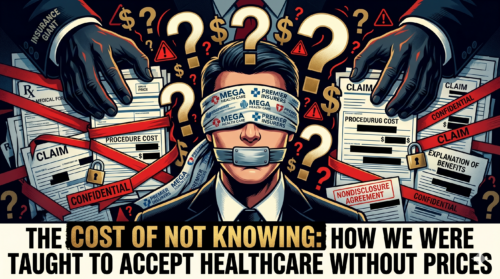
Most people have no idea.
And that’s not because they’re careless.
It’s because they’ve been trained not to ask.
For decades, Americans have been conditioned to accept a system where not knowing the price of something—something as important as your health—is considered normal.
You show up. You hand over your insurance card. You trust the system.
And then the bills come later.
This Is Not Normal
In no other area of your life would you tolerate this.
You wouldn’t buy a car without knowing the price.
You wouldn’t agree to build a house without an estimate.
You wouldn’t walk into a grocery store, fill your cart, and say, “Just charge me whatever you think is fair.”
But in healthcare, that’s exactly what we’ve been taught to do.
And over time, something else happens…
You start to believe that if you don’t understand it, it must be because you can’t understand it.
So you stop trying.
When Something Feels Too Broken to Be Real
There’s a psychological concept called normalcy bias—the tendency to assume things will continue as they always have, and to dismiss realities that feel too extreme or disruptive to be true.
“This can’t be happening… systems like this don’t exist.”
Layered on top of that is cognitive dissonance—the discomfort we feel when reality challenges what we’ve always believed.
So instead of questioning the system, we rationalize it:
- “There must be a reason.”
- “I probably just don’t understand it.”
- “This is just how healthcare works.”
And even deeper is system justification—our tendency to defend the very systems we depend on, even when they’re not serving us.
Because accepting that something this essential could be fundamentally broken… is uncomfortable.
So we normalize it.
What I See Every Single Day
I’m not looking at this from the outside.
As a Direct Primary Care physician, I’ve built a regional network of physicians, imaging centers, labs, and specialists who believe in something simple: great care with transparent pricing.
And because of that, I have a very different vantage point.
Every day, I sit with patients before they get care—not after the bill arrives.
We have real conversations:
- What will this cost you if you go through insurance?
- What is your deductible?
- What is your coinsurance?
- Do you actually know what your responsibility will be?
And then I show them the self-pay price.
Side by side.
Same service. Same quality.
Completely different numbers.
And I watch the moment it clicks.
Let’s Talk About Reality
Because when you step outside of the traditional system and look at actual pricing, the illusion falls apart fast:
- Vitamin D test billed at $200… actual cost around $17
- MRI billed at $4,000… real price often $400–$600
- X-ray billed at over $1,000… average cost $50–$100
- Colonoscopy billed at $11,000… real cost closer to $900
Not 2–3 times higher.
Ten. Twenty times higher.
Every. Single. Day.
This isn’t a glitch.
This is the system functioning exactly as it was built.
The Truth About Insurance
Insurance was never meant to cover everything.
It was meant for the unpredictable:
- The accident
- The surgery
- The hospitalization
Not your routine care.
But somewhere along the way, we flipped the model—and now people are using the most expensive, opaque system imaginable to pay for the most predictable parts of their health.
What Happens When You Actually Know
When patients understand pricing, everything changes:
- Direct Primary Care: ~$100/month
- Labs: $50–$70
- Dermatology visits: ~$250
- Mammograms: ~$200
- Medications: often a fraction of what they’ve been paying
Now healthcare becomes:
Predictable.
Understandable.
Transparent.
And insurance can return to what it was meant for—to protect against the unexpected.
So Ask Yourself This
Why are you expected to stay in the dark?
Why are the only tax-advantaged healthcare dollars—Health Savings Accounts (HSAs)—only available if you enroll in a specific type of insurance plan?
Not just any plan.
A high-deductible plan—typically offered by the same major carriers:
Blue Cross. United. Aetna. Cigna. Humana.
If you choose a different path—if you prioritize transparent pricing, direct care, or alternative models—you often lose access to one of the most powerful financial tools available.
Why?
Because the rules were written that way.
To be fair, HSAs were originally designed to pair with high-deductible plans—under the idea that if you take on more upfront cost, you should receive tax advantages.
But here’s the question that deserves more attention:
Why hasn’t that evolved?
Why aren’t all individuals empowered to use pre-tax dollars for their healthcare—regardless of how they choose to receive care?
Follow the Incentives
Healthcare policy doesn’t exist in a vacuum.
It is shaped—over time—by influence, lobbying, and financial incentives.
You can look it up.
You can see where political contributions come from.
You can see which industries spend the most shaping policy.
And you can start to connect the dots.
The Bottom Line
You were never meant to understand this system.
That was the point.
But you can.
And once you do—once you start seeing the real numbers, side by side, and understanding the psychology that kept you from questioning it—
everything shifts.
Because when you finally see what things actually cost…
you realize something powerful:
You don’t have to participate blindly.
You can choose differently.
Healthcare can be different—and it starts with transparency, trust, and putting people back at the center.