
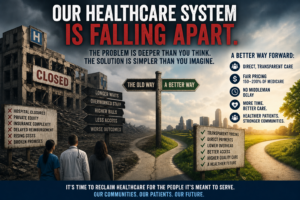
In the Philadelphia area, our healthcare systems are quietly falling apart. And it’s not just a perception—it’s reality.
This isn’t a sudden collapse. It’s been a slow unraveling—one that many of us working inside the system have been watching for years.
Crozer Keystone, once a critical lifeline for Delaware County, was acquired by private equity, systematically stripped of its resources, and ultimately shut down. Before that, Drexel University Hospital—formerly Hahnemann, a historic academic institution that trained generations of physicians—met a similar fate.
What’s often left out of these stories is this:
these closures were not just failures—they were profitable events for certain players along the way.
Hospitals are not always dismantled because they are beyond saving. In some cases, they are dismantled because the underlying assets—real estate, contracts, infrastructure—can be more valuable broken apart than preserved as a functioning healthcare institution.
By the time the hospital actually closes its doors, much of that value has already been extracted.
The community is left with fewer resources.
Healthcare workers are left without jobs or forced into strained systems.
Patients are left with longer travel times, overcrowded emergency rooms, and delayed care.
But along the way, money was made.
Not by the communities.
Not by the clinicians at the bedside.
It was made by investors and by those at the top—through deliberate, carefully structured financial strategies designed to extract value long before the doors ever closed.
And that’s what makes this so complex—and so difficult to fix.
Because this isn’t just a story of mismanagement.
It’s a story of incentives.
Over the past decade, nearly every independent hospital in our region has been absorbed into large health systems like Jefferson Health and Penn Medicine. Consolidation was sold to us as progress—more efficiency, better coordination, higher quality care.
But what many of us are witnessing on the ground tells a very different story.
Care has become more fragmented, not less. Wait times are longer. Staffing ratios are stretched thin. Decision-making has moved further away from the bedside and deeper into administrative and corporate layers. The people making the financial decisions are often far removed from the reality of patient care.
What was once considered some of the best healthcare in the country is becoming something people fear having to rely on—especially in moments when it matters most.
I saw this firsthand.
Last summer, my father developed sepsis. He was admitted to a local hospital—one that had once been a trusted community institution and is now part of a large system. His outcome could have been very different if he didn’t have a wife and two daughters in medicine advocating for him constantly—questioning decisions, pushing for timely interventions, ensuring he didn’t fall through the cracks.
That level of advocacy should not be a prerequisite for survival.
And yet, I hear versions of this story over and over again—from patients, colleagues, and friends. Not because the clinicians don’t care—but because the system they are working within is no longer designed to support safe, attentive, human-centered care.
Let’s be very clear about something:
This is not the fault of the physicians, nurses, or frontline staff.
They are showing up every day, doing extraordinary work under increasingly impossible conditions. They are understaffed, overextended, and navigating systems that prioritize documentation, billing, and throughput over connection, critical thinking, and time.
They are practicing in a model that has been hollowed out.
When people say—half-joking, half-serious—that they might die in the waiting room at a local hospital, it reflects something deeper than frustration. It reflects a loss of trust.
And trust, once lost in healthcare, is incredibly hard to rebuild.
So how did we get here?
Hospitals often point to low insurance reimbursements as the reason they cannot staff adequately or maintain services. And while reimbursement challenges are real, they are only one piece of a much larger, more complex—and frankly more troubling—picture.
Because at the same time, these very hospitals are financially entangled in the insurance structures that are draining them.
Think about this:
A hospital system pays millions of dollars in premiums each year to companies like Blue Cross to insure its employees.
One of those employees—a nurse practitioner, for example—needs care and sees a physician within that same hospital system.
That physician provides the care… and then bills the insurance company.
The insurance company—who already collected premiums from the hospital—then determines how much of that money will be paid back to the hospital for services it already delivered within its own network.
The hospital then employs entire departments—billing specialists, coders, administrators—whose sole job is to navigate this process, appeal denials, resubmit claims, and chase payment.
Months pass. Payments are delayed, reduced, or denied.
So the hospital pays the insurer…
to get paid back a fraction of its own money…
after investing massive administrative overhead to retrieve it.
In what other industry does this model exist?
This is not a system designed for efficiency.
It is a system designed for extraction.
And if you think this dysfunction is limited to large systems, it’s not.
We recently spoke with a smaller hospital system that is actively struggling—citing delayed and inadequate insurance reimbursements as a major driver of their financial instability.
And yet, they are still operating within this same structure.
They are using a major insurer as the third-party administrator for their own self-funded employee health plan.
Think about that.
This hospital system is funding its employees’ healthcare with its own dollars. Their employees are strongly incentivized—financially pressured, in many cases—to stay within the hospital’s own network for care.
So in theory, this should be the most efficient model possible.
But instead:
- The hospital funds the plan
- The administrator manages it
- Pricing is dictated externally
- And the hospital ends up paying 400–800% of Medicare rates for care delivered within its own system to its own employees
All while paying administrative fees to the same type of entity that is already delaying and underpaying them on the reimbursement side.
There is a far simpler alternative.
They could pay directly for that care out of their own self-funded pool at a rational, transparent rate—something like 150–200% of Medicare—without the administrative drag, without the delays, and without the middleman extracting value.
And this is where people often ask:
“But who administers the plan if it’s not a company like Blue Cross?”
The answer is: it doesn’t have to look the way it does today.
There are modern administrators that operate with full transparency and far lower overhead—handling claims, eligibility, and payments without embedding themselves as profit-driving gatekeepers in the care itself.
In many cases, payment can be remarkably simple:
a patient receives care, and with a quick approval, a virtual payment card can be generated—sometimes instantly, even via text—allowing the provider to be paid directly, clearly, and without months of back-and-forth.
No chasing claims.
No opaque pricing.
No waiting for partial reimbursement.
The infrastructure already exists to make this simple.
What’s missing is not capability—it’s the willingness to step outside of a system that has trained us to believe this complexity is necessary.
And importantly, this dysfunction is not centered around rare, catastrophic events.
This is happening in the realm of routine, predictable care—the very foundation of a healthy population:
- Primary care visits
- Preventive screenings
- Basic labs
- Chronic disease follow-up
- Every imaging study—from X-rays to ultrasounds, CT scans, and MRIs
We have normalized the idea that in order to access these services, we must first pay a third-party intermediary to grant permission—and then accept whatever price or process follows.
It is financially wasteful.
It is operationally unsustainable.
And increasingly, it is eroding the quality of care.
There is another way.
A growing number of physicians, employers, and patients are beginning to step outside of this model and ask a simple but powerful question:
What if we paid directly for routine care?
When patients—or employers—pay providers directly:
- Pricing becomes transparent
- Administrative overhead drops dramatically
- Physicians can spend more time with patients
- Care becomes proactive instead of reactive
This is the foundation of models like Direct Primary Care, transparent imaging centers, and cash-based lab services.
It doesn’t eliminate the need for insurance. It reframes it.
Insurance should exist for what it was originally designed for:
large, unpredictable, catastrophic events.
Not as a tollbooth for every blood pressure check, every lab draw, every imaging study, or every conversation about your health.
If we continue to rely on the current structure for everything, we will continue to see local systems strain, consolidate, and in some cases, collapse.
If we want to preserve access to meaningful, high-quality care in our communities, we have to be willing to rethink how we engage with the system itself.
Because right now, whether we realize it or not, we are feeding the very structures that are contributing to its decline.
And that’s something we can no longer afford to ignore.
Dana Mincer, DO
Love Health Direct Primary Care
Medical Health Benefits Advisor | Community Advocate | Positive Healthcare Disruptor